Stop Accidentally Harming Your Website’s Search Visibility

Everyday website updates like a new title, a changed website address, an uploaded image, can quietly undermine your search engine rankings a little at a time. This free guide gives your team the guardrails to publish with confidence.
Free Download

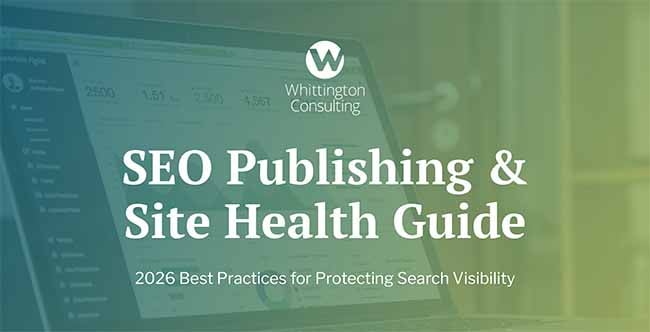
The 2026 SEO Publishing & Site Health Guide

Every web page edit, image upload, link change, or new piece of content affects how search engines and AI tools understand, evaluate, and surface your site.

This concise, practical guide gives your team clear publishing guardrails to protect search performance, site health scores, page experience, and AI discoverability.

Cover image: 2026 SEO Publishing & Site Health Guide

The hidden risks

Small Changes. Big Consequences.

Most SEO damage doesn’t come from major redesigns. It comes from routine, well-intentioned updates made by teams who simply don’t know the risks. Sound familiar?

Changed a URL for clarity?

Without a permanent redirect, you’ve just broken every link pointing to that page and reset its search authority to zero.

Updated a page title?

A well-ranking title that gets rewritten without care can cause a significant drop in click-through rates and rankings overnight.

Uploaded a large image?

Oversized, uncompressed images slow your page load times, hurting both user experience and your Core Web Vitals scores.

Accidentally blocked a page?

A single misconfigured indexing setting can make an entire page invisible to search engines, and is a surprisingly common mistake.

Inside the guide

Everything Your Team Needs to Publish Safely

This is not a dense technical manual. It’s a practical, 6-page reference guide designed to be consulted every time you publish, covering every high-risk element of your website.

Page Titles & Meta Descriptions

Best practices for writing titles and descriptions that drive clicks without sacrificing existing rankings.

Headings & Content Structure

How to use H1s, H2s, and H3s to organize content for users, search engines, and AI systems alike.

URLs / High-Risk Changes

Why changing a URL is one of the most disruptive SEO actions, and the exact protocol to follow if you must.

Internal Linking & Content Connections

How to link pages together in a way that builds authority and helps AI tools understand your site’s structure.

Images, Accessibility & Performance

Simple rules for ALT text, image compression, and file sizing that protect page speed and accessibility.

AI Search & Generative Results Readiness

2026-specific guidance on structuring content to appear in AI-generated summaries and answer engines.

Crawlability, Indexing & Page Health

How to confirm your pages are actually visible to search engines and free of hidden technical errors.

Safe vs. Risky Content Changes

A clear, at-a-glance checklist of which updates are safe to make and which require expert review first.

Content Freshness & Review Cadence

How often to audit your content and what to look for to keep your site accurate, trusted, and competitive.

Who this is for?

Built for Companies Who Publish

You don’t need to be an SEO expert to use this guide. It was designed specifically for the teams and individuals responsible for day-to-day website management.

Marketing Managers and Teams

Content Creators & Editors

Website Managers

Small Business Owners

Frequently Asked Questions

Why is changing a page title considered a risk?

Page titles are one of the most powerful signals search engines use to determine a page’s topic and relevance. A title that is already performing well has earned its ranking through established signals. Rewriting it without careful consideration can disrupt those signals, causing click-through rates and rankings to drop, sometimes significantly and quickly.

What is "AI search readiness" and why does it matter in 2026?

AI Search Readiness means structuring your website’s content so that AI-powered search engines—like the AI features in Google and Bing, and tools like ChatGPT and Perplexity—can easily find, understand, and accurately summarize your information. As more users receive answers directly from AI rather than clicking through to websites, being structured for AI discoverability is becoming just as important as traditional SEO.

What is the single most damaging mistake teams can make when updating their website?

One of the most common and damaging mistakes is changing a page’s URL (address) without immediately implementing a permanent redirect. This breaks every external link pointing to that page, signals to search engines that the page no longer exists, and effectively resets the page’s authority, often resulting in a complete loss of its previous rankings.

Is this guide technical? Do I need an SEO background to use it?

Not at all. The guide was written specifically for non-experts, such as the marketers, writers, and managers who are on the front lines of publishing content every day. It translates complex SEO concepts into plain-language rules that anyone can follow, with clear “do this” and “avoid this” guidance throughout.

How often should we review our website's SEO health?

The guide recommends a layered approach: continuous monitoring of key metrics, focused spot-checks on a quarterly basis, and a thorough review after any major site update or redesign. High-value pages should also be reviewed at least once per year to ensure their content remains accurate, current, and competitive.

What does "duplicate content" mean and why is it a problem?

Duplicate or overlapping content occurs when multiple pages on your website answer the same question or cover the same topic. This confuses search engines, which struggle to determine which page to rank, and can dilute the authority of both pages. The guide covers how to identify and consolidate near-duplicate content to strengthen your site’s overall search performance.

What if I need more than a guide? Can Whittington Consulting help directly?

Absolutely. The guide is a great starting point, but every website has unique challenges. Whittington Consulting offers Technical SEO and AEO (Answer Engine Optimization) audits that provide a comprehensive, site-specific analysis with actionable recommendations. If you’re ready for a deeper look, reach out to request an audit.

Protect Your Most Valuable Marketing Asset

Your website is the foundation of your digital presence. Don’t let preventable publishing mistakes undermine its performance. Download the guide today and give your team the clarity they need to publish with confidence.