
A failed website project costs more than just money, resulting in lost opportunities and months of wasted time. According to the Project Management Institute, 14% of IT projects fail completely, and 31% don't meet their original goals. For website redesigns, poor vendor selection is often the root cause.
Most businesses focus on two criteria: portfolio quality and price. While these factors matter, they don't reveal whether a website design agency can actually deliver on time, communicate effectively, or support your site after launch.
The right questions expose how an agency works, not just what they've built. Ask these four strategic questions to find a partner who will help your website become a revenue-generating asset, not a source of frustration.
Quick Reference: The 4 Critical Questions
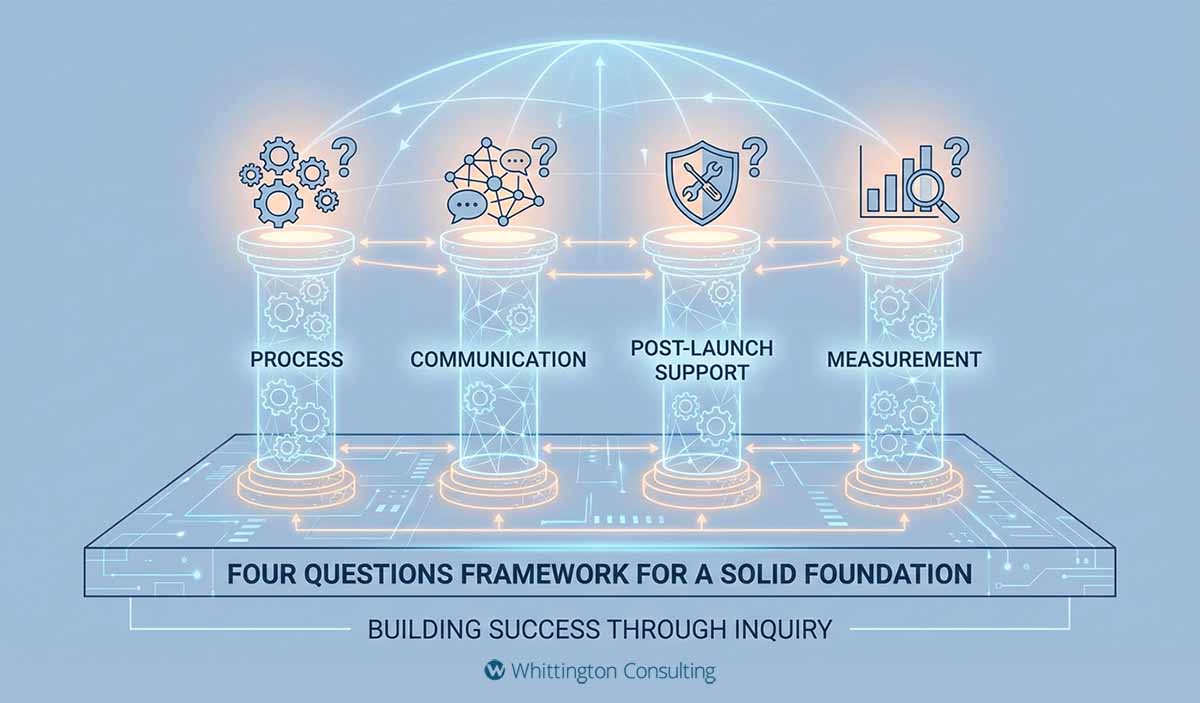
To properly vet a potential website partner, you must ask questions that reveal their process, communication habits, post-launch support, and success metrics.
- What's your complete development process?
- How do you handle communication and project management?
- What happens after launch?
- How do you measure and report success?
Use these questions to move beyond surface-level vendor comparisons and identify agencies that align with your business goals.
Question 2: How Do You Handle Communication and Project Management?
The Hidden Cost of Poor Communication
According to The Standish Group, ineffective communication is a factor in 57% of all project failures. For website projects, communication breakdowns manifest as missed deadlines, scope creep, and disappointing results.
Poor communication costs you in three ways:
- Time delays: Waiting days for responses or clarification extends your timeline
- Budget overruns: Misunderstandings lead to rework and additional charges
- Quality issues: Assumptions replace clarity, resulting in a site that doesn't meet your needs
B2B companies face unique communication challenges. Your website might need to integrate with your CRM, reflect complex service offerings, or satisfy multiple stakeholder groups. Without clear communication channels, these requirements get lost or misinterpreted.
Essential Communication Elements
Evaluate agencies on these communication factors:
Point of Contact Structure
- Will you have a dedicated project manager, or will you work with multiple team members?
- Who makes final decisions on the agency side?
- How do you escalate urgent issues?
Update Frequency and Format
- How often will you receive progress updates (daily, weekly, bi-weekly)?
- What format will updates take (email summaries, video calls, dashboard access)?
- Will you have visibility into task completion and upcoming milestones?
Response Time Expectations
- What's the typical response time for questions or concerns?
- Are there specific hours when the team is available?
- How do time zones affect communication if you're working with a distributed team?
Tools and Systems That Matter
Modern agencies use technology to streamline communication:
- Project management platforms: Tools like Teamwork, Asana, Monday.com, or Basecamp provide transparency into task status and deadlines.
- Communication channels: Dedicated Slack channels or Microsoft Teams spaces for quick questions.
- File sharing: Organized systems for sharing designs, content, and assets with version control.
- Progress tracking: Dashboards that show completed work, current tasks, and upcoming phases.
Ask to see examples of how the agency uses these tools. A quick demo reveals whether they have mature systems or are figuring it out as they go.
Question 3: What Happens After Launch?
Why Post-Launch Support Defines Success
Launch day is the beginning, not the end. Your website is a living asset that requires ongoing attention to remain secure, fast, and effective.
Consider what happens in the weeks after launch:
- Security updates: Content management systems and plugins need regular updates to prevent vulnerabilities.
- Performance optimization: Real user data reveals opportunities to improve load times and user experience.
- Content management: Your team needs training to update pages, publish blog posts, and manage forms.
- Bug fixes: Issues that didn't appear in testing may emerge with real traffic.
You are left scrambling to find support when problems arise if your agency disappears after launch. The best partners view launch as the start of a long-term relationship.
Support Models to Evaluate
Ask about these post-launch support elements:
Warranty Period
- How long after launch will the agency fix bugs at no charge?
- What qualifies as a bug versus a new feature request?
- What's the response time for critical issues during the warranty period?
Maintenance Packages
- What ongoing maintenance options are available?
- Do packages include security updates, backups, and uptime monitoring?
- How are emergency fixes handled outside of regular maintenance?
Training and Documentation
- Will your team receive training on the content management system?
- Is training live, recorded, or both?
- What documentation will you receive for managing and updating the site?
Questions About Long-term Partnership
Think beyond immediate post-launch needs:
- Scalability planning: How will the site accommodate growth in traffic, content, or functionality?
- Feature additions: What's the process for adding new capabilities six months or a year after launch?
- Technology updates: How does the agency handle major platform updates or migrations?
- Knowledge transfer: If you eventually bring website management in-house, will the agency support the transition?
These questions reveal whether an agency thinks strategically about your long-term success or just wants to complete the project and move on.
Question 4: How Do You Measure and Report Success?
Beyond Launch Day Metrics
A successful website launch means nothing if the site doesn't drive business results. The best agencies define success in terms of business impact, not just technical completion.
Effective measurement includes:
Business Impact
- Lead generation (form submissions, demo requests, contact inquiries)
- Revenue influence (deals sourced from website traffic)
- Cost per acquisition compared to other channels
User Experience Indicators
- Bounce rate and time on site
- Pages per session and navigation patterns
- Conversion rates for key user journeys
Technical Performance
- Page load speed and Core Web Vitals scores
- Mobile usability and responsiveness
- Search engine rankings for target keywords
SEO and Organic Growth
- Organic traffic trends
- Keyword rankings and visibility
- Backlink profile and domain authority
Reporting That Drives Decisions
Ask how the agency will help you understand performance:
- Dashboard access: Will you have real-time access to analytics, or will you rely on periodic reports?
- Report frequency: How often will you receive formal performance reports?
- Insight depth: Do reports just show numbers, or do they include analysis and recommendations?
- Goal alignment: How does reporting connect to your specific business objectives?
Focus on agencies that provide actionable insights, not just vanity metrics like page views that look impressive but fail to inform strategy.

Accountability and Optimization
The best partnerships include ongoing optimization:
- Performance guarantees: Some agencies offer specific commitments around load speed or uptime.
- Optimization recommendations: Regular suggestions for improving conversion rates and user experience.
- A/B testing capabilities: Tools and expertise to test different approaches and identify what works.
- Continuous improvement: A mindset of iteration rather than "set it and forget it."
Ask for examples of how the agency has helped past clients improve performance after launch. Specific case studies demonstrate their commitment to long-term results.
Bonus Considerations for B2B Companies
B2B websites have unique requirements that consumer-focused agencies may not understand:
Industry Experience
Has the agency worked with companies in your industry or with similar business models? Industry experience means they understand your buyers, sales cycles, and competitive environment.
Compliance and Security
Do you operate in a regulated industry like healthcare or financial services? Ensure the agency understands HIPAA, SOC 2, or other relevant compliance requirements.
Technology Integration
Your website likely needs to connect with your CRM, marketing automation platform, and other business systems. Verify the agency has experience with your specific tech stack, particularly if you use HubSpot, Salesforce, or similar platforms.
Lead Generation Focus
B2B websites exist to generate qualified leads. Look for agencies that understand lead capture strategies, progressive profiling, and how to design for longer, more complex buyer journeys.
Making Your Decision
Choosing a website design partner is one of the most important marketing decisions you'll make. The right agency becomes a strategic partner who understands your business and helps you achieve your goals. The wrong choice costs you time, money, and opportunity.
Use these four questions to evaluate potential partners:
- What's your complete development process? (Look for structure and predictability)
- How do you handle communication and project management? (Ensure transparency and responsiveness)
- What happens after launch? (Verify ongoing support and partnership)
- How do you measure and report success? (Confirm focus on business results)
The answers will reveal far more than any portfolio or pricing proposal.
Ready to Build a Website That Drives Revenue?
Whittington Consulting is a digital marketing agency that helps companies make their websites into sales engines. We specialize in HubSpot consulting, SEO, inbound marketing, and website redesign to generate qualified leads and grow revenue.
We've guided hundreds of companies through successful website projects. Our structured process, transparent communication, and focus on measurable results ensure your website becomes a strategic asset, not a source of frustration.
Ready to build a website that drives revenue? Schedule your free, no-obligation consultation today to discuss your website project needs.
Want to see our approach in action? Explore our website design and development services or review successful B2B website projects we've completed for companies like yours.