Several times, the question has come up about whether you can use HubSpot inbound marketing software if you already have a WordPress website. The answer is still, "absolutely."
WordPress remains the most widely used content management system on the web. W3Techs reported on July 2, 2026 that WordPress is used by 41.5% of all websites and 59.2% of websites with a known CMS. That is a big reason so many companies want to keep WordPress for their website and use HubSpot for marketing automation, CRM, forms, email, reporting, and sales follow-up.
What you may not know is that HubSpot and WordPress can work together cleanly to make your WordPress website a more useful lead generation tool. If you need help setting up HubSpot and WordPress, you can learn more about our HubSpot Consulting service.
WordPress and HubSpot Integration Points
For most WordPress websites, the first integration point is the HubSpot WordPress plugin. HubSpot's own tracking-code documentation recommends the plugin for WordPress sites because it automatically installs the HubSpot tracking code and connects the site to HubSpot without editing theme files.
You can still install the HubSpot tracking code manually, but that should usually be the fallback, not the first choice. HubSpot says the tracking code should be added before the closing </body> tag on externally hosted pages. On WordPress, that means you either use the plugin, ask a developer to add the code globally, or deploy it through a tag manager if your setup requires that.
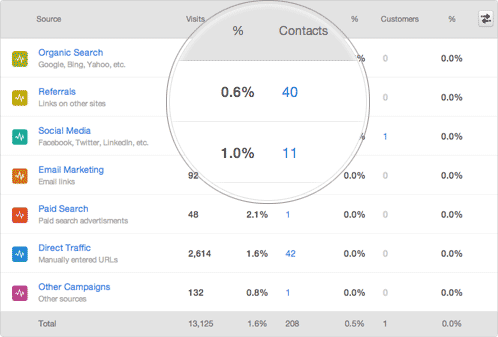
Once the tracking code is in place, HubSpot can recognize visitors and page views on your WordPress site, associate known contacts with activity, capture many non-HubSpot form submissions, and support tools such as live chat. The tracking code does not magically create your strategy or fix weak offers, but it gives HubSpot the data it needs to connect website behavior to contacts and campaigns.
HubSpot forms can also be embedded on WordPress pages, landing pages, and blog posts. If you already use a WordPress form plugin, check whether your form data is actually reaching HubSpot in a clean, usable way. For a B2B website, the goal is to put the right contact, company, source, page, and offer data into the CRM so sales and marketing can act on it, then notify them of the new contact.
If you publish landing pages in HubSpot while keeping your main site on WordPress, you can still make the experience feel consistent. The practical work is making sure your landing page templates, forms, thank-you pages, tracking, and follow-up workflows match the way your WordPress site is structured.
You can also place HubSpot calls to action, meeting links, chatflows, and embedded forms inside WordPress content. That is often enough for a company that wants to keep WordPress as the website CMS but use HubSpot as the marketing and sales system behind it.
Lead Generation for WordPress Websites Without Using HubSpot
Any company with a serious digital sales channel is eventually going to connect its website with marketing automation software and a CRM. If you are trying to prove the idea before making a bigger commitment, you may decide to use a smaller collection of WordPress plugins and standalone tools.
That can work, but it is rarely as simple as installing one plugin. A typical cobbled-together WordPress lead generation stack might include Gravity Forms or WPForms for forms, OptinMonster for pop-ups, Mailchimp or ActiveCampaign for email, Google Analytics 4 and Looker Studio for reporting, Zapier or Make to move data between systems, and a CRM such as Salesforce, Pipedrive, or Zoho CRM. None of those tools are bad tools. The issue is that someone still has to make them work together.
I'm not going to pretend that HubSpot is affordable for every business. HubSpot still offers free and starter plans, but the real cost depends on the hubs, seats, contacts, and features your team actually needs. That is why the comparison should not be "HubSpot versus one WordPress plugin." The better comparison is HubSpot versus the total cost and risk of stitching together forms, pop-ups, email, landing pages, analytics, CRM updates, notifications, and reporting across several tools.
There are plenty of WordPress lead capture plugins, form builders, pop-up tools, email marketing tools, automation tools, and landing page plugins that can help you capture leads. Some are good for a narrowly focused job. For example, OptinMonster is still a well-known tool for opt-in forms and pop-ups, but it is not the same thing as a CRM-connected marketing automation platform.
That distinction matters. A form plugin can collect a name and email address. A stronger inbound marketing setup connects that form submission to the original traffic source, page path, content offer, lifecycle stage, sales owner, follow-up workflow, and reporting.
If you build that yourself, you also have to manage separate subscriptions, plugin updates, field mapping, tracking scripts, privacy settings, reporting gaps, and the inevitable moments when one tool changes and the handoff breaks. If you are building a serious inbound marketing program, those connections are where the value is.
One drawback to using several WordPress plugins to accomplish your lead management with WordPress is that each separate plugin requires updating. You run the risk of a plugin author discontinuing the plugin, changing the pricing model, weakening support, or creating a compatibility issue after a WordPress, theme, or PHP update. More importantly, you can lose the clean lead data that makes follow-up useful.
When HubSpot and WordPress Are a Good Fit
HubSpot and WordPress are a good fit when your website is already working as the front door for sales conversations, but your follow-up, lead data, and reporting are too scattered. In that situation, WordPress can remain the publishing platform while HubSpot becomes the system that captures leads, nurtures contacts, scores interest, alerts sales, and shows which campaigns are creating qualified opportunities.
This setup is especially useful for B2B companies that need more than contact forms. If your buyers research before they talk to sales, download resources, compare service providers, and return to the site multiple times, HubSpot gives you a cleaner way to manage that journey. For more on that aspect of our work, see our lead generation and lead nurturing services.
HubSpot and WordPress are probably not the right combination if you only need a basic brochure site, if no one will own the CRM data, or if your team does not have a plan for email, workflows, reporting, and sales follow-up. The software can support the process, but it will not create the process for you. The same is true for the cobbled-together option: a stack of plugins and subscriptions can support the process, but someone still has to own the process.
So Why Pay For HubSpot?
I am obviously partial to HubSpot because I chose it to run our website, blog, marketing automation, and CRM, and we've seen a return on that investment. It manages leads through the entire sales funnel better than a collection of disconnected WordPress plugins does.
Perhaps the biggest advantage to HubSpot is that it is an integrated platform, supported by HubSpot's documentation, training, partner ecosystem, and support options. There's simply no plug-in, paid or free, that does what HubSpot does across the whole customer journey. It's really not a fair comparison.
The real question comes down to this. Does your company want to rely on a patchwork of WordPress plugins when new business is at stake?