Case Study
A financial services organization that provides retirement and healthcare funding programs for public-sector employees needed HubSpot to support a complex network spanning hundreds of local government entities, departments, schools and individual plan participants.
Its sales, service and field teams all needed a shared view of those relationships. Instead, an overly complicated CRM structure was fragmenting information, creating duplicate work and preventing the organization from rolling HubSpot out to the full team.
Whittington Consulting helped the organization replace that fragile setup with a simpler, more sustainable HubSpot architecture. Then we did the detailed work of restructuring the data, improving service processes, and training employees to use the system consistently.
The Challenge
A CRM That Duplicated Work Instead of Simplifying It
Our client had begun implementing HubSpot with another consultant. Because members of its team had previously used Salesforce, the original HubSpot portal was designed to separate prospective and current customers into different custom objects.
That approach did not fit the way HubSpot naturally manages the customer journey. Emails, calls, meetings and notes were recorded on standard company and contact records, while workflows attempted to copy the same activities and properties into four or five custom objects.
The result was a system that became harder to maintain with every change. Information appeared in different places, workflows did not always synchronize records correctly and employees could not reliably see a complete customer history. The organization paused its rollout while it tried to determine how to fix the underlying structure.
Its business relationships added another layer of complexity. One local government could include a fire department, police department, public works department and other participating groups. School districts could have multiple schools beneath them. The CRM needed to preserve those parent-and-child relationships while connecting the appropriate contacts, plan participants and service activity to each organization.
Just as important, the system needed to be easy for part-time field representatives to use. The client's operational vision was straightforward: representatives should be able to quickly write a few notes on each meeting or call before moving on. If updating HubSpot required too much time or technical knowledge, adoption would suffer, and our client would have to continue working without a complete view of client activity.
The organization did not need another vendor waiting for step-by-step instructions. It needed a HubSpot consultant who could understand the desired business outcome, challenge an unsustainable approach, and recommend a better way forward.
Our Solution
Rebuilding HubSpot Around One Connected Customer Journey
Our review led to a candid recommendation: stop forcing a Salesforce-style architecture into HubSpot and rebuild the portal around HubSpot's native company and contact records.
We explained why the existing approach would become increasingly difficult to support. Every new property or process would require more workflows to keep the custom objects synchronized, creating additional opportunities for incomplete or inconsistent data. Although we could have continued maintaining that system, it would not have provided the reliable, scalable foundation the organization needed.

Once the client approved the new direction, Whittington Consulting handled both the strategy and the execution:
Retired several custom objects that unnecessarily separated prospects, customers and related activity.
Moved and reassociated information from those objects into native Company and Contact records, carefully reviewing records to preserve the correct relationships.
Created parent-and-child Company relationships to represent local governments, departments, school districts, and individual schools.
Rebuilt service ticket processes, including the appropriate ticket properties, record-creation forms and association requirements.
Established a structure that keeps emails, calls, meetings, notes and service activity connected to the appropriate Company and Contact history.
Configured HubSpot's sensitive-data capabilities for personally identifiable information (PII), including masked Social Security numbers.
Documented the new processes in standard operating procedures.
Trained the organization's customer service and sales teams to use the redesigned system correctly.
The turning point was not a particular HubSpot feature. It was the willingness to question the original architecture, explain the business consequences clearly and recommend a simpler solution, even though rebuilding it required significant hands-on data work.
The Result
One Organized Source of Truth, and a System Worth Recommending
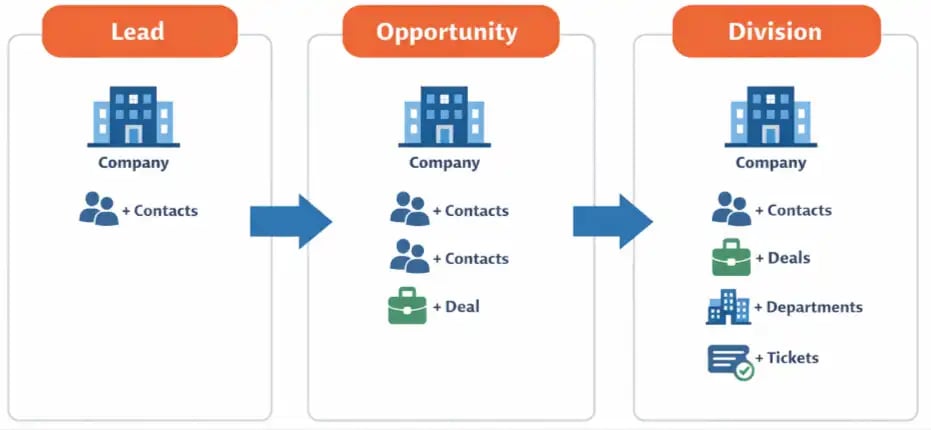
Our client now has a maintainable CRM foundation built around the full customer journey. Rather than searching across standard and custom objects, authorized employees can review a company's or participant's history in one place.
Parent-and-child relationships reflect the way the organization actually serves public-sector employers, while redesigned ticketing processes give service teams a more consistent way to capture and manage requests.
The new architecture also creates a stronger foundation for reporting and accountability. Activities are associated with the records where HubSpot is designed to store them, making the data easier to trace and reducing the need for fragile synchronization workflows. Sensitive participant information can be protected within HubSpot's secure-data framework.
As with any CRM implementation, technology is only part of the equation. The organization continues working to build consistent usage habits among its distributed field representatives. The redesigned HubSpot portal, training and SOPs give leadership a practical foundation for that ongoing adoption effort without carrying forward the structural problems that had stalled the original rollout.
The clearest indication of the client's confidence came after the project. Its Director of Service and Support referred Whittington Consulting to another company experiencing similar HubSpot frustrations.
Client testimonial
“I've recently been telling my colleague how much more organized our system has become since working with your team. I specifically mentioned how great your team has been at taking the time to understand our exact needs.”
Director of Service and Support
Ready to Get More From HubSpot?
If your CRM feels harder to manage than the business process it is supposed to support, adding another workflow may not solve the underlying problem. Whittington Consulting can help you evaluate the structure, simplify the system and build HubSpot around the outcomes your team needs.
You can learn more about our HubSpot consulting services here, as well as request an initial conversation to answer your questions and discuss what a more useful HubSpot portal could look like for your organization.
Ready to make your marketing a sales engine?
Let’s have an initial conversation to answer any questions and discuss how it works for your business.

Recent Blogs