
One major aim of a B2B website redesign is to improve your interaction with potential customers and help the right prospects understand why your company is worth considering. For a marketing director or CMO, that means the redesign has to do more than just "look better." The website has to create better sales conversations, reduce wasted traffic, and support measurable marketing results.
You might think artwork and graphic design are the most important aspects of your website redesign, but it's more complicated than that. There are three things that you need to "nail," and if you do, you'll be on your way to turning your website into a sales engine.
This article will show you which three elements are most important, and how you can implement them in your site without losing sight of the business reason for the redesign.
1. Customer-Driven Design
The aesthetics, as well as the usability of your site, determine whether visitors choose to stay and browse or leave. A strong redesign starts with the buyer, not the home page mockup. To come up with a customer-driven site, you need to:
- Define who your intended audience is, understand what information they are looking for, and state it plainly so they can easily understand it.
- Come up with a modern, uncluttered user interface that is easy to understand and navigate.
- Have legible fonts, a color scheme, and photography that is accessible and appeals to your audience.
- Create a consistent layout with the important elements marked and clearly visible.
- Make the next step obvious for each type of visitor: early-stage researcher, active buyer, customer, applicant, partner, or referral.
For a B2B website redesign, this is also where marketing leaders should be disciplined about budget. If the redesign makes the site prettier but does not clarify your positioning, your best-fit audience, and the paths that produce qualified leads, the project will be hard to defend later. Good user experience supports lead generation because it removes friction from the buyer's decision process.
2. Relevant Content
To increase the chances of a website redesign being successful, you need to deliver valuable content to your intended audience as quickly as possible. Perform a content audit on your current site and take stock of what you have and what needs to be added. Then, survey your audience and use web analytics to evaluate which content most visitors are reading, and update that content and use it to get better results.
That audit should not stop at page inventory. Look for the questions a serious buyer needs answered before they will talk with sales:
-
Who you help
-
What problems your business solves
-
How your process works
-
What makes your business credible
-
What a project usually involves
-
Cost considerations
-
What a prospect should consider before spending money.
Those content gaps can become stronger service pages, comparison content, case studies, or lead-generation offers.
If you are planning a redesign because the current site is not producing enough qualified demand, a content gap analysis can help identify missing buyer information.
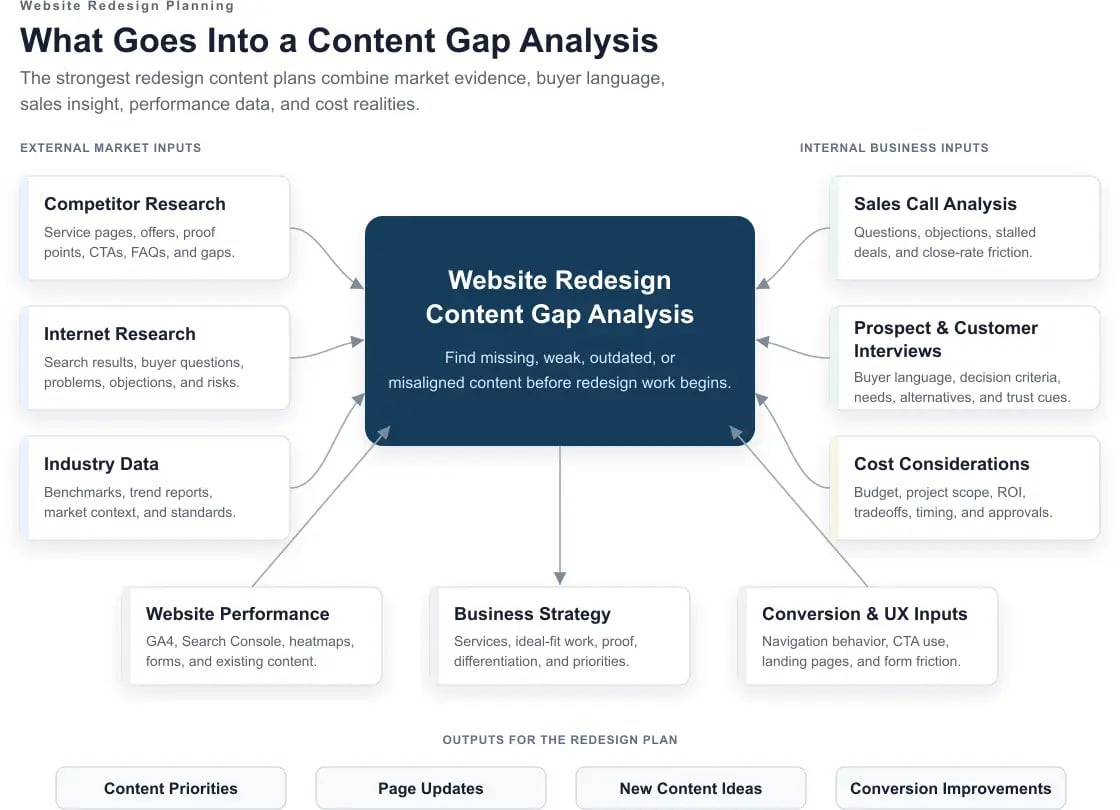
For a recent client website redesign for Shenandoah Valley Partnership, we analyzed 18 months of economic development RFIs they received. We analyzed language, source industry, topics of the questions the RFIs asked for, and who at the companies were asking for the information. We made design and content decisions based on actual prospect data, helping to produce a more relevant website for their intended audience.
3. Calls to Action
Your website should be aimed at getting visitors to perform some kind of action. Thus, it is important that you provide calls to action throughout your website to prompt your visitors to do something specific. Your calls to action should be very obvious and clear, and you can achieve this by:
- Using colors that contrast the background of the site, so that the call to action buttons stand out.
- Making call to action graphics large enough to stand out and place them where they are clearly visible.
- Writing the words in your call to action in a straightforward way, thereby getting visitors to do the specific action you want them to.
- Keep it simple. Make it an easy process for visitors to carry out the action.
Briefly set an expectation of what people can expect when they click. If the call to action is to download your whitepaper, give them a couple of bullets on how the whitepaper will benefit them.
For marketing leaders, the question is whether each call to action matches the visitor's stage of buying readiness. A visitor comparing vendors may be ready to schedule a consultation. A visitor still learning about the problem may need a useful guide, checklist, assessment, or example first. Strong landing pages and simple forms help turn those actions into trackable opportunities instead of anonymous website traffic.
There are many things that you should pay attention to during website redesign, but by ensuring that you have a customer-focused website, relevant content, and clear calls to action, you will be able to use your website more effectively to generate leads and sales. Those three elements also give your team a better way to judge the success of the redesign: not just by whether the site launched, but by whether it helps the right prospects understand, trust, and contact your company.
If you are considering a website redesign, here are a few free resources we offer to help:
- Website lead calculator - helps determine if your current website is an effective lead generator
- Guide containing questions to ask before your next website redesign
- Guide to website redesign cost
- Website budget planner - answer 6 questions and immediately get a website redesign budget range for your unique situation
Last updated: July 2026